Radio Smart LED Strip
This document will guide you through the Radio Smart LED Strip project. You will be able to interact with your LED strip in Node-RED and control Power appliance using 16A Relay.
Block Concept

Requirements
-
Either Control Set, or individual components:
- 1x Cover Module
- 1x Core Module
- 1x Power Module
- 1x AC/DC ADAPTER 5V/4A (or higher current rating)
- 1x 3D printed enclosure BCE301
-
Other components:
- 1x Radio Dongle (not included in the kit)
- 1x RGB or RGBW Digital LED strip (not included in the kit)
- Micro USB cable (not included in the kit)
-
One of these options:
- HARDWARIO Playground installed (recommended) You can find more information in the Quick Start Guide document.
- Raspberry Pi with the HARDWARIO Raspbian distribution You can find more information in the document Raspberry Pi Installation.
- HARDWARIO Firmware Tool installed You can find more information in the document Toolchain Setup.
Firmware Upload
In this procedure we will use the HARDWARIO Playground to upload firmware to the Core Module.
Step 1: Connect the Micro USB cable to the Core Module and your computer
Step 2: Flash firmware
Run the HARDWARIO Playground. In the Firmware tab choose and upload the bcf-radio-power-controller- firmware to the Core Module:
If your LED strip is 144 LEDs RGBW:
bcf-radio-power-controller-rgbw144
If your LED strip is 150 LEDs RGB:
bcf-radio-power-controller-rgb150
If your LED strip is 72 LEDs RGBW:
bcf-radio-power-controller-rgbw72
Flashing Core Module R1 & R2 For differences of flashing older Core Module 1 and newer Core Module 2 please read Core Module R1 and R2 comparison in the Hardware section
Step 3: Remove the Micro USB cable from the Core Module and your computer
At this point your firmware is successfully uploaded
Hardware Assembling
See short video with easy step by step demonstration:
Step 1: Start with the Power Module
Make sure the Power Module does not have power adapter inserted.
Step 2: Plug the Core Module on top of the Power Module
Step 3: Plug the Cover Module on top of the Core Module
Step 4: Put assembled modules into the enclosure BCE301 and fix it with O-rings
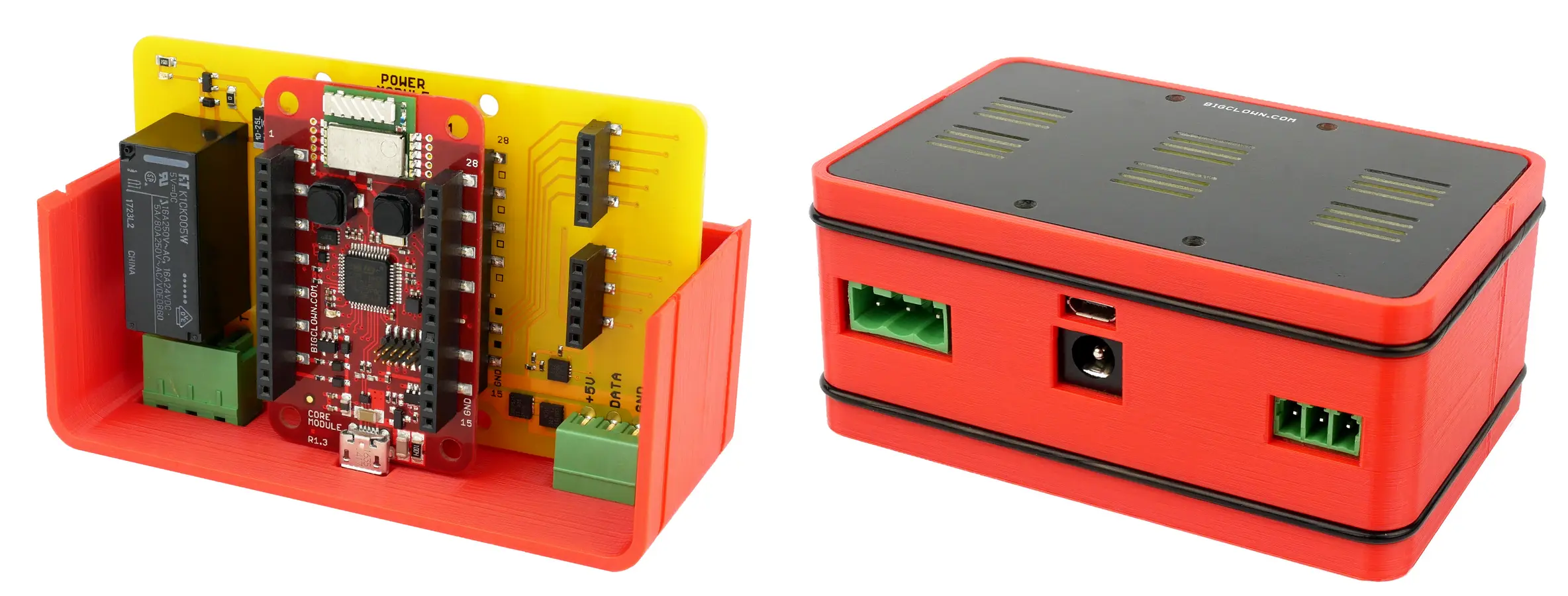
Step 5: Connect the LED strip to the pluggable socket on the right side
Step 6: Connect the 5V DC Power Jack
Playground Bootstrap
If you are using the new HARDWARIO Playground, then use the Functions tab instead of using http://localhost:1880/. Also the pairing process is now done in Devices tab. For communication test use the Messages tab.
Step 1: Open Node-RED in your web browser
Step 2: You should see the empty workspace with Flow 1
Step 3: Insert the following snippet in the flow (using Menu >> Import >> Clipboard) and click in Flow 1 tab, then deploy
[{"id":"2fc604fc.3b6abc","type":"inject","z":"dfc861b.b2a02a","name":"List all gateways","topic":"gateway/all/info/get","payload":"","payloadType":"str","repeat":"","crontab":"","once":false,"x":560,"y":460,"wires":[["a2c10833.24d5d8"]]},{"id":"1e4502b8.2f63fd","type":"inject","z":"dfc861b.b2a02a","name":"Start node pairing","topic":"gateway/usb-dongle/pairing-mode/start","payload":"","payloadType":"str","repeat":"","crontab":"","once":false,"x":570,"y":580,"wires":[["795ff5a7.8e266c"]]},{"id":"3d844ce2.932864","type":"inject","z":"dfc861b.b2a02a","name":"Stop node pairing","topic":"gateway/usb-dongle/pairing-mode/stop","payload":"","payloadType":"str","repeat":"","crontab":"","once":false,"x":560,"y":640,"wires":[["5967c452.c838bc"]]},{"id":"f202b253.2705b","type":"inject","z":"dfc861b.b2a02a","name":"List paired nodes","topic":"gateway/usb-dongle/nodes/get","payload":"","payloadType":"str","repeat":"","crontab":"","once":false,"x":560,"y":520,"wires":[["f0aca138.0b2c3"]]},{"id":"349f02fd.890f6e","type":"inject","z":"dfc861b.b2a02a","name":"Unpair all nodes","topic":"gateway/usb-dongle/nodes/purge","payload":"","payloadType":"str","repeat":"","crontab":"","once":false,"x":560,"y":700,"wires":[["2f1c5bb6.53d6f4"]]},{"id":"cf61d75d.4ad8f8","type":"mqtt in","z":"dfc861b.b2a02a","name":"","topic":"#","qos":"2","broker":"67b8de4a.029d3","x":530,"y":400,"wires":[["a5cb0658.f5d658"]]},{"id":"a5cb0658.f5d658","type":"debug","z":"dfc861b.b2a02a","name":"","active":true,"console":"false","complete":"false","x":790,"y":400,"wires":[]},{"id":"a2c10833.24d5d8","type":"mqtt out","z":"dfc861b.b2a02a","name":"","topic":"","qos":"","retain":"","broker":"717f7c18.ba0a24","x":770,"y":460,"wires":[]},{"id":"f0aca138.0b2c3","type":"mqtt out","z":"dfc861b.b2a02a","name":"","topic":"","qos":"","retain":"","broker":"717f7c18.ba0a24","x":770,"y":520,"wires":[]},{"id":"795ff5a7.8e266c","type":"mqtt out","z":"dfc861b.b2a02a","name":"","topic":"","qos":"","retain":"","broker":"717f7c18.ba0a24","x":770,"y":580,"wires":[]},{"id":"5967c452.c838bc","type":"mqtt out","z":"dfc861b.b2a02a","name":"","topic":"","qos":"","retain":"","broker":"717f7c18.ba0a24","x":770,"y":640,"wires":[]},{"id":"2f1c5bb6.53d6f4","type":"mqtt out","z":"dfc861b.b2a02a","name":"","topic":"","qos":"","retain":"","broker":"717f7c18.ba0a24","x":770,"y":700,"wires":[]},{"id":"67b8de4a.029d3","type":"mqtt-broker","z":"","broker":"127.0.0.1","port":"1883","clientid":"","usetls":false,"compatmode":true,"keepalive":"60","cleansession":true,"willTopic":"","willQos":"0","willPayload":"","birthTopic":"","birthQos":"0","birthPayload":""},{"id":"717f7c18.ba0a24","type":"mqtt-broker","z":"","broker":"127.0.0.1","port":"1883","clientid":"","usetls":false,"compatmode":true,"keepalive":"60","cleansession":true,"willTopic":"","willQos":"0","willPayload":"","birthTopic":"","birthQos":"0","birthPayload":""}]
It will look like this:
This snippet provides control buttons for gateway/radio commands. These commands are sent over the MQTT protocol.
Step 4: Deploy the flow using the Deploy button in the top-right corner
Step 5: Open the debug tab
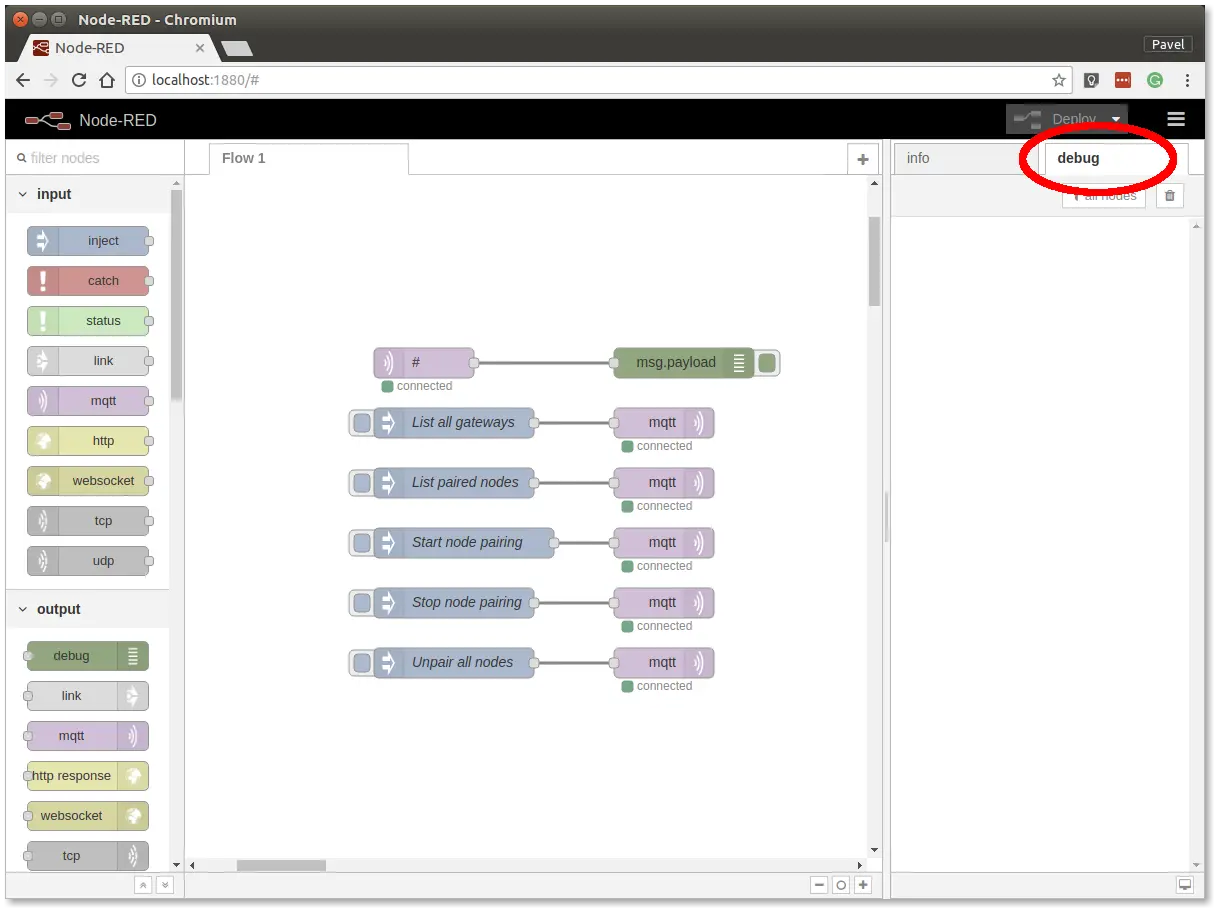
In the debug tab, you will be able to see all the MQTT messages.
Step 6: Click on the List all gateways button. You should see a response like this in the debug tab
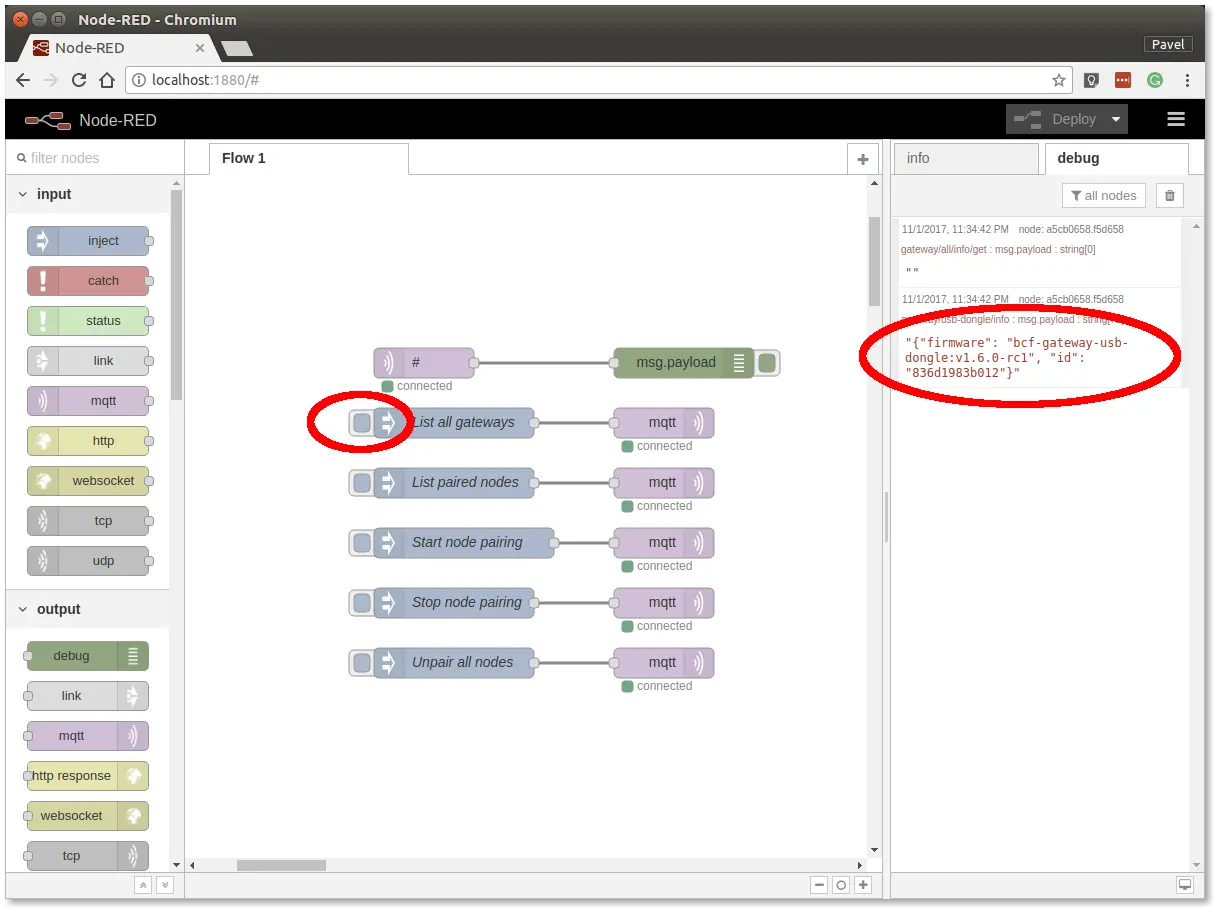
At this point, you've got working Node-RED, MQTT, HARDWARIO Radio Dongleand HARDWARIO Gateway.
Radio Pairing
In this section, we will create a radio link between the Radio Dongle and the Radio Smart LED strip.
Follow these steps in Node-RED:
Step 1: Click on the Start node pairing button
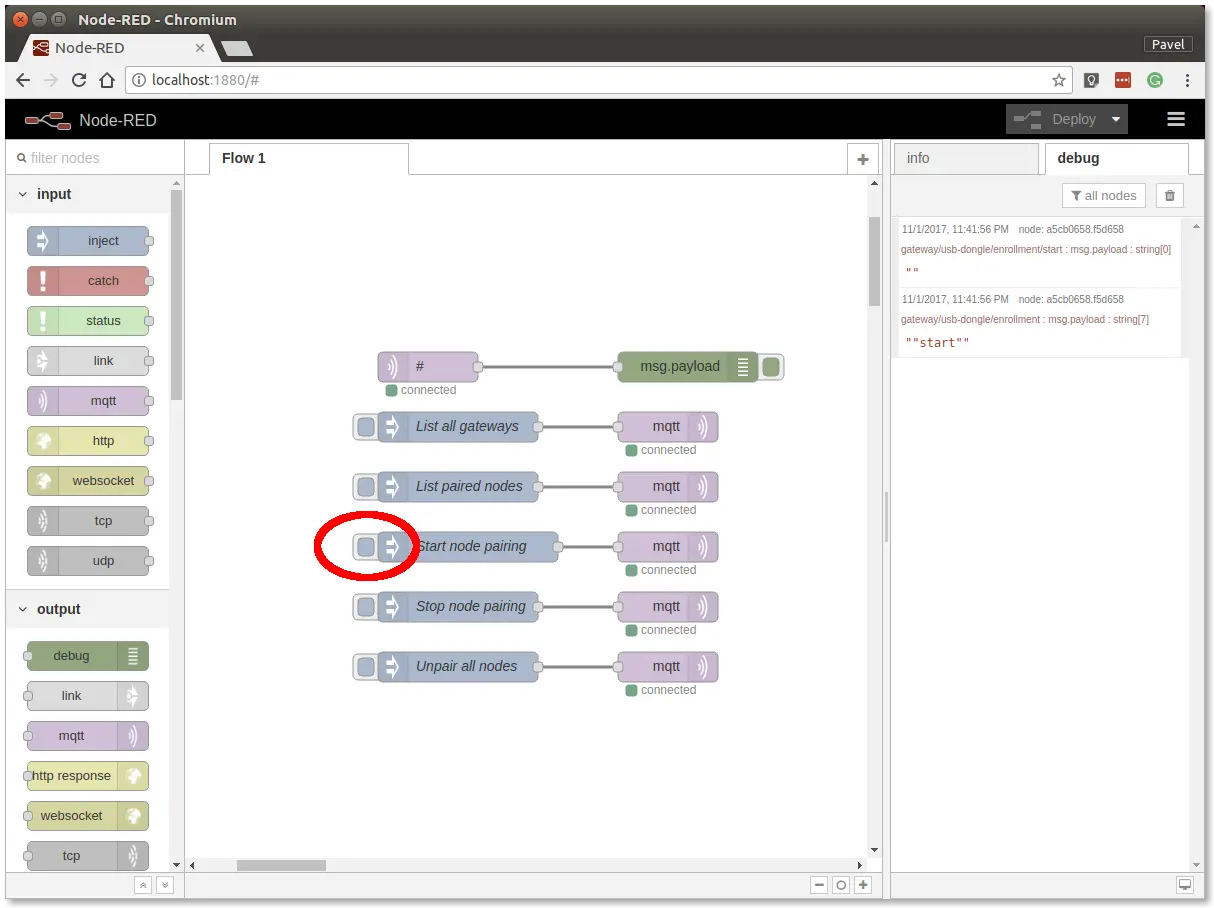
Step 2: Connect the power adapter into the Radio Power Controller to send the pairing request (you should also see the red LED on the Core Module to be on for about 2 seconds)
Step 3: Click on the Stop node pairing button
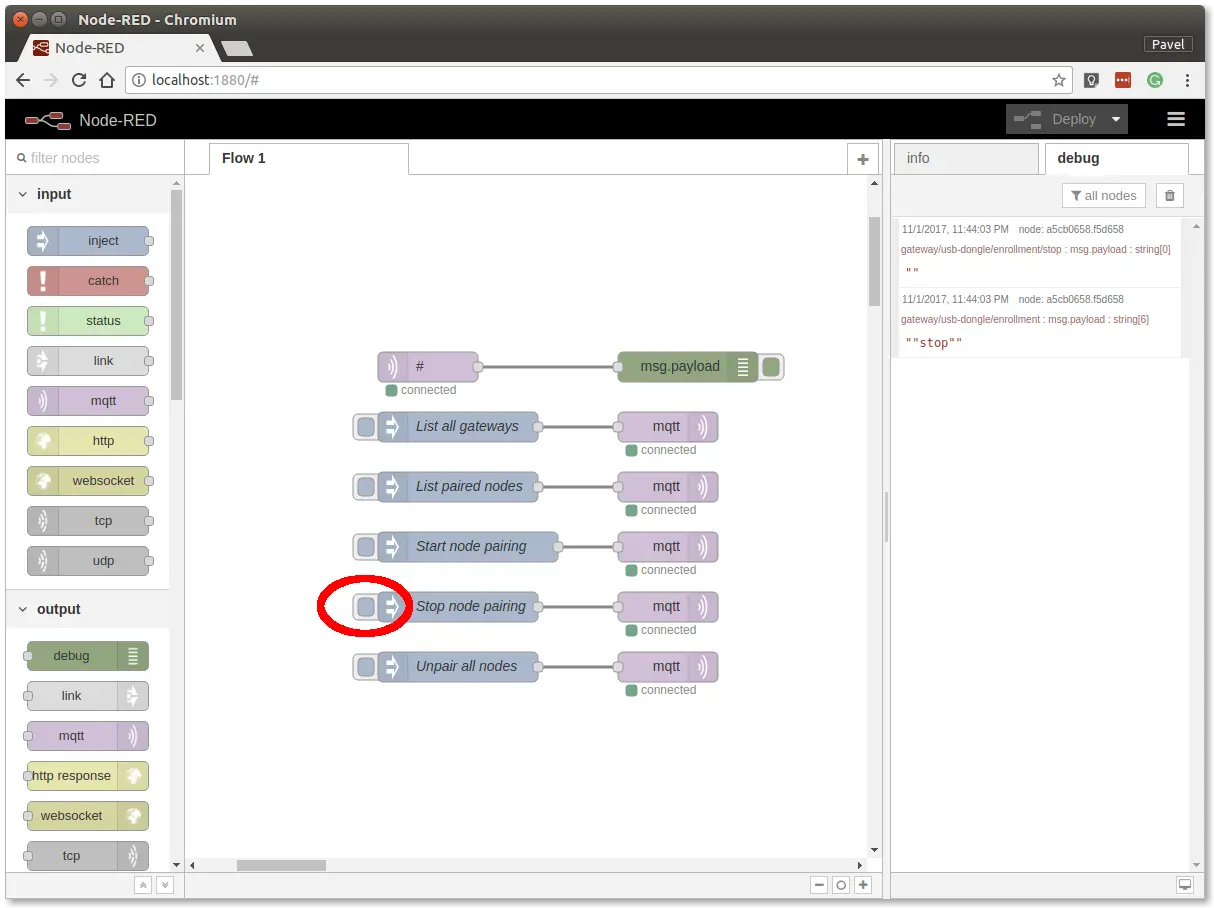
At this point, you've got established a radio link between the node (Radio Smart LED Strip) and the gateway (Radio Dongle).
Communication Test
Follow these steps in Node-RED:
Step 1: Switch to debug tab on the right
Step 2: Insert the following snippet in the flow (using Menu >> Import) and click in Flow 1 tab
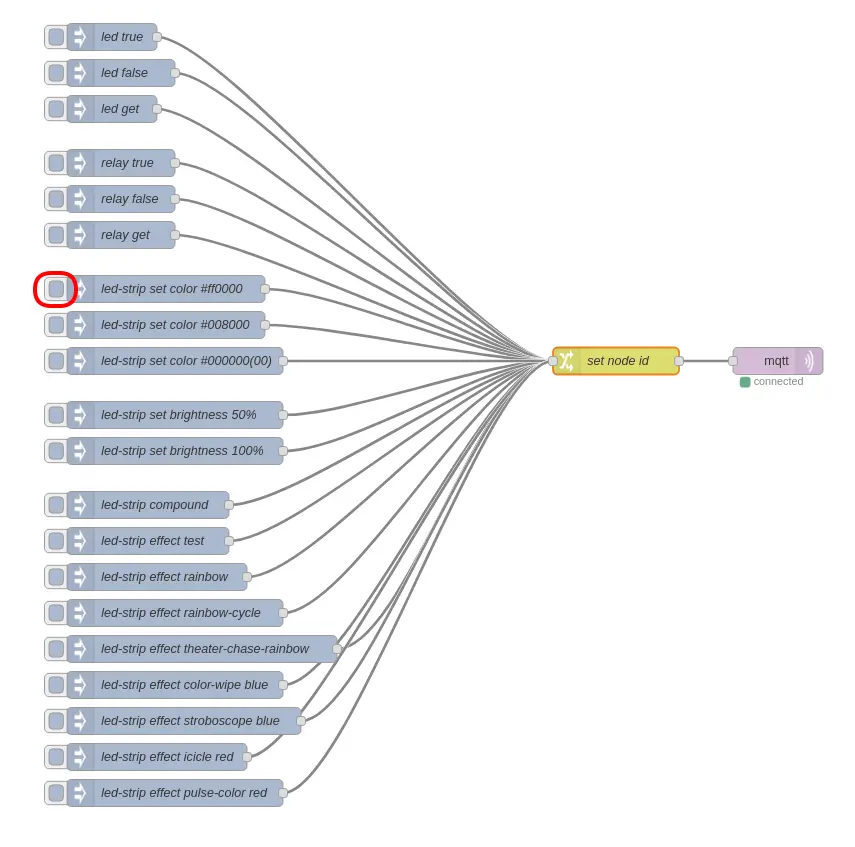
[{"id":"c81deb91.e6df28","type":"inject","z":"6115d89b.b435c8","name":"led true","topic":"node/{id}/led/-/state/set","payload":"true","payloadType":"bool","repeat":"","crontab":"","once":false,"onceDelay":"","x":150,"y":40,"wires":[["fc940043.2c94c"]]},{"id":"e865057.ad650f8","type":"inject","z":"6115d89b.b435c8","name":"led false","topic":"node/{id}/led/-/state/set","payload":"false","payloadType":"bool","repeat":"","crontab":"","once":false,"onceDelay":"","x":160,"y":80,"wires":[["fc940043.2c94c"]]},{"id":"f4eda4ad.e61008","type":"inject","z":"6115d89b.b435c8","name":"relay true","topic":"node/{id}/relay/-/state/set","payload":"true","payloadType":"bool","repeat":"","crontab":"","once":false,"onceDelay":"","x":160,"y":180,"wires":[["fc940043.2c94c"]]},{"id":"d068e0ba.850d9","type":"inject","z":"6115d89b.b435c8","name":"relay false","topic":"node/{id}/relay/-/state/set","payload":"false","payloadType":"bool","repeat":"","crontab":"","once":false,"onceDelay":"","x":160,"y":220,"wires":[["fc940043.2c94c"]]},{"id":"4b02e13b.874a7","type":"inject","z":"6115d89b.b435c8","name":"led get","topic":"node/{id}/led/-/state/get","payload":"null","payloadType":"json","repeat":"","crontab":"","once":false,"onceDelay":"","x":150,"y":120,"wires":[["fc940043.2c94c"]]},{"id":"b8aadc82.6fb1a","type":"inject","z":"6115d89b.b435c8","name":"relay get","topic":"node/{id}/relay/-/state/get","payload":"null","payloadType":"json","repeat":"","crontab":"","once":false,"onceDelay":"","x":160,"y":260,"wires":[["fc940043.2c94c"]]},{"id":"39fb65a3.c426ea","type":"inject","z":"6115d89b.b435c8","name":"led-strip set color #ff0000","topic":"node/{id}/led-strip/-/color/set","payload":"\"#ff0000\"","payloadType":"str","repeat":"","crontab":"","once":false,"onceDelay":"","x":210,"y":320,"wires":[["fc940043.2c94c"]]},{"id":"c820ce88.576dd","type":"inject","z":"6115d89b.b435c8","name":"led-strip set color #008000","topic":"node/{id}/led-strip/-/color/set","payload":"\"#008000\"","payloadType":"str","repeat":"","crontab":"","once":false,"onceDelay":"","x":210,"y":360,"wires":[["fc940043.2c94c"]]},{"id":"edcffa41.db6bf8","type":"inject","z":"6115d89b.b435c8","name":"led-strip compound","topic":"node/{id}/led-strip/-/compound/set","payload":"[20, \"#ff0000\", 20, \"#ff7f00\", 20, \"#ffff00\", 20, \"#00ff00\", 20, \"#0000ff\", 20, \"#960082\", 24, \"#D500ff\"]","payloadType":"json","repeat":"","crontab":"","once":false,"onceDelay":"","x":190,"y":560,"wires":[["fc940043.2c94c"]]},{"id":"f145c1a6.00731","type":"inject","z":"6115d89b.b435c8","name":"led-strip effect test","topic":"node/{id}/led-strip/-/effect/set","payload":"{\"type\":\"test\"}","payloadType":"json","repeat":"","crontab":"","once":false,"onceDelay":"","x":190,"y":600,"wires":[["fc940043.2c94c"]]},{"id":"94faa725.2a6638","type":"inject","z":"6115d89b.b435c8","name":"led-strip effect rainbow","topic":"node/{id}/led-strip/-/effect/set","payload":"{\"type\":\"rainbow\", \"wait\":50}","payloadType":"json","repeat":"","crontab":"","once":false,"onceDelay":"","x":200,"y":640,"wires":[["fc940043.2c94c"]]},{"id":"50812ed8.45f09","type":"inject","z":"6115d89b.b435c8","name":"led-strip effect rainbow-cycle","topic":"node/{id}/led-strip/-/effect/set","payload":"{\"type\":\"rainbow-cycle\", \"wait\":50}","payloadType":"json","repeat":"","crontab":"","once":false,"onceDelay":"","x":220,"y":680,"wires":[["fc940043.2c94c"]]},{"id":"1c45c443.698d6c","type":"inject","z":"6115d89b.b435c8","name":"led-strip effect theater-chase-rainbow","topic":"node/{id}/led-strip/-/effect/set","payload":"{\"type\":\"theater-chase-rainbow\", \"wait\":50}","payloadType":"json","repeat":"","crontab":"","once":false,"onceDelay":"","x":250,"y":720,"wires":[["fc940043.2c94c"]]},{"id":"695dee35.ff264","type":"inject","z":"6115d89b.b435c8","name":"led-strip set brightness 50%","topic":"node/{id}/led-strip/-/brightness/set","payload":"50","payloadType":"str","repeat":"","crontab":"","once":false,"onceDelay":"","x":220,"y":460,"wires":[["fc940043.2c94c"]]},{"id":"f11b54bb.3fd3f8","type":"inject","z":"6115d89b.b435c8","name":"led-strip set brightness 100%","topic":"node/{id}/led-strip/-/brightness/set","payload":"100","payloadType":"str","repeat":"","crontab":"","once":false,"onceDelay":"","x":220,"y":500,"wires":[["fc940043.2c94c"]]},{"id":"efb0acf7.7808c","type":"inject","z":"6115d89b.b435c8","name":"led-strip effect color-wipe blue","topic":"node/{id}/led-strip/-/effect/set","payload":"{\"type\":\"color-wipe\", \"wait\":50, \"color\": \"#0000ff\"}","payloadType":"json","repeat":"","crontab":"","once":false,"onceDelay":"","x":220,"y":760,"wires":[["fc940043.2c94c"]]},{"id":"c2d7e432.c76cc8","type":"inject","z":"6115d89b.b435c8","name":"led-strip set color #000000(00)","topic":"node/{id}/led-strip/-/color/set","payload":"\"#000000(00)\"","payloadType":"str","repeat":"","crontab":"","once":false,"onceDelay":"","x":220,"y":400,"wires":[["fc940043.2c94c"]]},{"id":"e4691220.e3747","type":"mqtt out","z":"6115d89b.b435c8","name":"","topic":"","qos":"","retain":"","broker":"a6621c71.92f09","x":890,"y":400,"wires":[]},{"id":"fc940043.2c94c","type":"change","z":"6115d89b.b435c8","name":"set node id","rules":[{"t":"change","p":"topic","pt":"msg","from":"{id}","fromt":"str","to":"power-controller:0","tot":"str"}],"action":"","property":"","from":"","to":"","reg":false,"x":710,"y":400,"wires":[["e4691220.e3747"]]},{"id":"fcca537f.99cac","type":"inject","z":"6115d89b.b435c8","name":"led-strip effect stroboscope blue","topic":"node/{id}/led-strip/-/effect/set","payload":"{\"type\":\"stroboscope\", \"wait\":50, \"color\":\"#0000ff\"}","payloadType":"json","repeat":"","crontab":"","once":false,"onceDelay":"","x":230,"y":800,"wires":[["fc940043.2c94c"]]},{"id":"23fe88e4.4dc058","type":"inject","z":"6115d89b.b435c8","name":"led-strip effect icicle red","topic":"node/{id}/led-strip/-/effect/set","payload":"{\"type\":\"icicle\", \"wait\":50, \"color\":\"#ff0000\"}","payloadType":"json","repeat":"","crontab":"","once":false,"onceDelay":"","x":200,"y":840,"wires":[["fc940043.2c94c"]]},{"id":"811a0f5b.8f1ee","type":"inject","z":"6115d89b.b435c8","name":"led-strip effect pulse-color red","topic":"node/{id}/led-strip/-/effect/set","payload":"{\"type\":\"pulse-color\", \"wait\":200, \"color\":\"#ff0000\"}","payloadType":"json","repeat":"","crontab":"","once":false,"onceDelay":"","x":220,"y":880,"wires":[["fc940043.2c94c"]]},{"id":"a6621c71.92f09","type":"mqtt-broker","z":"","broker":"127.0.0.1","port":"1883","clientid":"","usetls":false,"compatmode":true,"keepalive":"60","cleansession":true,"birthTopic":"","birthQos":"0","birthPayload":"","willTopic":"","willQos":"0","willPayload":""}]
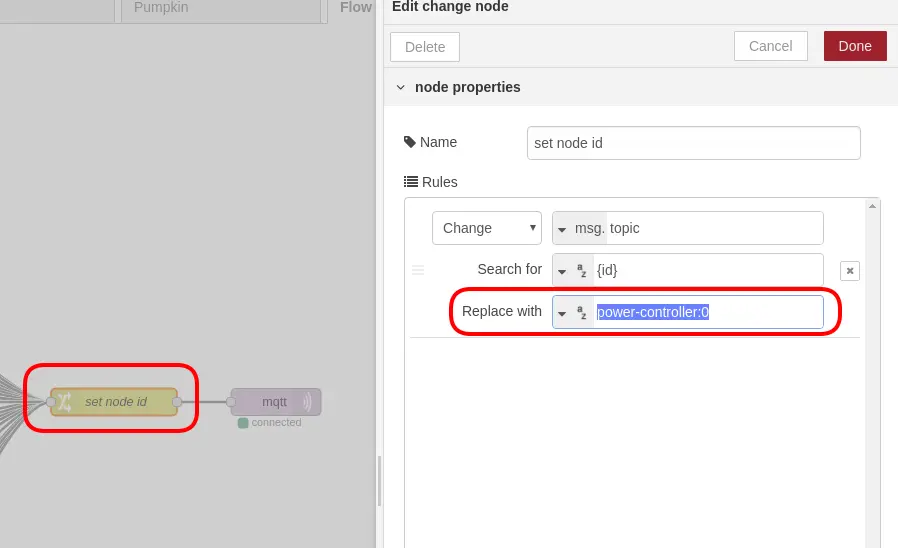
Step 3: Edit set node id node, and change "Replace with" to your node id, e.g. kit-power-controller:0 (you can find your node id by clicking on List paired nodes)
Step 4: Press led-strip set color #ff0000