Theory
Time allocation: 10 min.
Light
Light is the visible part of electromagnetic radiation. Its frequency ranges from about 3.9×10¹⁴ to 7.9×10¹⁴ Hz, which corresponds to wavelengths in a vacuum of 390 to 760 nm.
This band lies between ultraviolet (UV) and infrared (IR) radiation. Some fields of science also count a wider spectrum, reaching into the UV and IR, as light.
Light can be described in several ways:
- Photometrically: for example by luminous intensity or luminous flux
- Colorimetrically: by its color and spectrum
- By its coherence and polarization
These properties determine how light behaves when it is reflected, refracted, passes through a material, interferes or diffracts.
Thanks to wave–particle duality, light has the properties of both particles and waves.
We perceive different frequencies of light as different colors: from red (lowest frequency, longest wavelength) to violet (highest frequency, shortest wavelength).
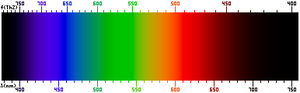
Beyond the visible spectrum, on the short-wave side, lies UV radiation, which acts on human skin and causes tanning. On the opposite side is IR radiation: the human eye cannot see it, but we feel its heat through receptors in the skin.
Visual comfort
Illuminance is one of the main parameters of the indoor environment. Enough light has a positive effect on our mood, performance and health. It helps create a pleasant atmosphere and improves concentration and overall comfort.
Besides the amount of light, the color of light matters too. Even “white” light comes in several shades:
- Warm white: resembles the light of an incandescent bulb. It feels cozy and is used mainly in living rooms, bedrooms and children's rooms. Its drawback is that details are harder to see.
- Cool white: a more neutral light that shows contrast more clearly. It suits kitchens, bathrooms and toilets.
- Daylight white: a bright, slightly bluish shade close to daylight. It is often used in well-lit workspaces.
RGB
RGB is a color model built on three primary colors: red, green and blue. It is used for mixing emitted light, for example in monitors and projectors. Unlike the CMYK model, RGB needs no external light source, because the device emits light itself.
Standard wavelengths:
- Red: 700 nm
- Green: 546.1 nm
- Blue: 435.8 nm
Colors are created by combining the intensities of these components:
| R | G | B | Color |
|---|---|---|---|
| 0 | 0 | 0 | Black |
| 255 | 0 | 0 | Red |
| 0 | 255 | 0 | Green |
| 0 | 0 | 255 | Blue |
| 255 | 255 | 0 | Yellow |
| 255 | 0 | 255 | Magenta |
| 0 | 255 | 255 | Cyan |
| 255 | 255 | 255 | White |